
Rather watch than read?
👉 Watch the short video walkthrough here.
And scroll to the end for our library of Mental Health resources!
Mental health is no longer a nice-to-have benefits conversation. It is a core workforce issue that affects performance, retention, and total cost of care.
And to address this growing issue, organizations are navigating real trade-offs:
The challenge is no longer whether to offer mental health support… it’s how to design it intentionally.
A few data points help frame why this decision matters:
When care is hard to access, issues escalate quietly… and the downstream impact shows up everywhere else in the organization.
Rather than comparing programs feature-by-feature, it’s more useful to evaluate them along two dimensions:
As acuity increases, cost typically follows. Strategic benefit design is about understanding where each option fits on that curve — and how different layers of support can work together.
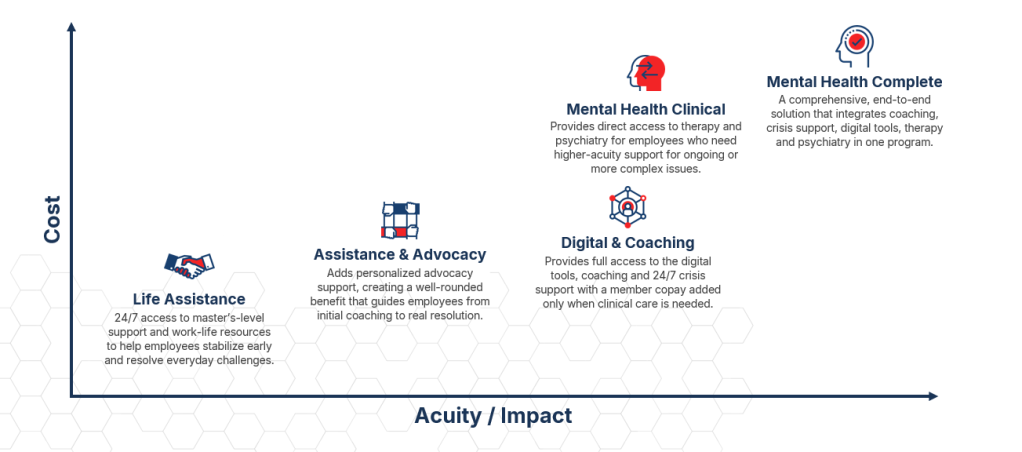
Life Assistance Programs are designed to provide immediate, accessible support when someone is feeling overwhelmed or unsure where to turn.
They typically include:
24/7 access to licensed, master’s-level clinicians
Trained professionals who can listen, assess the situation, and help individuals stabilize emotionally in the moment.
Short-term emotional support and problem-solving
Focused conversations that help people slow down, clarify what’s going on, and identify practical next steps.
Work-life resources
Support for common stressors such as caregiving challenges, financial or legal concerns, workplace issues, and major life transitions.
Guided referrals and navigation
Help connecting individuals to appropriate next steps, including other benefits or community-based resources.
Life Assistance is not a replacement for therapy or psychiatry. Instead, they function as an early intervention layer… helping people regain orientation and avoid escalation when possible. When positioned correctly, they offer a meaningful improvement over having no mental health support at all.
When advocacy is layered onto Life Assistance, the benefit becomes far more hands-on and outcome-driven.
In addition to emotional support and guidance, advocates actively step in to help move issues forward, including:
Healthcare navigation on the member’s behalf
Helping individuals understand their benefits, identify appropriate providers, and navigate a system that is often confusing and time-consuming.
Benefit maximization and problem-solving
Advocates work to ensure existing benefits are used effectively… addressing issues such as coverage questions, billing challenges, or care coordination gaps.
Active follow-through and resolution
Rather than pointing someone in the right direction, advocates help close the loop… coordinating next steps and tracking progress until issues are resolved.
This approach reduces friction, shortens time to care, and improves follow-through… particularly for individuals who feel overwhelmed or stuck navigating the healthcare system on their own.
For many organizations, digital mental health with coaching delivers the strongest balance of access, affordability, and impact.
This model typically includes:
24/7 digital mental health tools
Self-guided resources that support stress management, mindfulness, sleep, and emotional regulation — available whenever individuals need them.
Coaching focused on resilience and behavior change
Ongoing support that helps people build healthier habits, manage day-to-day challenges, and develop skills that prevent issues from escalating.
Crisis support at no cost to the member
Immediate access to help during high-stress moments, providing stabilization and guidance when it matters most.
On-demand access to therapy and psychiatry when needed (with a consult fee)
Clinical care is available quickly and conveniently, typically on a pay-per-use basis rather than as a fixed-cost benefit.
Care is delivered faster and with less friction than traditional pathways, often at a lower overall cost… making this approach a practical middle ground for organizations that want meaningful mental health support without over-committing financially.
Clinical-only mental health programs are designed to provide direct access to licensed clinicians for individuals with higher-acuity needs.
These programs focus exclusively on:
Therapy with licensed mental health professionals
Structured, clinical conversations addressing diagnosed or diagnosable mental health conditions.
Psychology services
Assessment, evaluation, and ongoing therapeutic support as appropriate.
Psychiatry services
Medical oversight of mental health conditions, including evaluation and treatment planning.
Prescribing when clinically appropriate
Medication management delivered virtually, following the same standards of care as in-person visits.
This virtual model closely mirrors the traditional in-office experience… offering convenience and faster access without changing the clinical nature of care. While effective for higher-acuity needs, it typically does not include the preventative, coaching, or resilience-building components found in more comprehensive mental health programs.
Mental Health Complete brings together preventative support, coaching, and clinical care into a single, fully integrated mental health program.
Unlike digital and coaching models where clinical visits are accessed on a per-use basis, Mental Health Complete is designed as a fully cost-included benefit… members have access to the full spectrum of services without co-pays, including therapy and psychiatry.
It typically includes:
24/7 digital mental health tools
Resources supporting stress management, mindfulness, sleep, and emotional regulation.
Coaching and resilience-building support
Ongoing guidance focused on behavior change, coping skills, and emotional wellbeing.
Crisis support at no cost to the member
Immediate access during high-stress or urgent situations.
Therapy, psychology, and psychiatry
Integrated clinical care delivered virtually, without additional cost at the point of service.
Prescribing and medication management when appropriate
Coordinated within the same ecosystem to ensure continuity of care.
By removing co-pays for clinical care and eliminating handoffs between levels of support, Mental Health Complete reduces friction at the moments people are least equipped to navigate it. It is the most comprehensive option available and is well-suited for organizations seeking predictable costs and a fully integrated mental health strategy.
Mental health benefits shouldn’t be chosen in isolation or reduced to a line item. They should be designed with intention.
Different populations require different levels of support. Different budgets demand different trade-offs. The goal isn’t to buy the most or the least… it’s to buy what works.
At Call A Doctor Plus, our role is to help brokers and employers align cost, acuity, access, and outcomes… so mental health benefits deliver real value to the organization and meaningful support to the people it serves.
Let’s schedule a chat to explore what makes the most sense for your clients!
For those who want to go deeper, we’ve created tools to support more informed decision-making:
📄 Mental Health Comparison Guide (PDF)
Side-by-side view of services, features, and cost considerations
👉 [Download the Comparison Guide]
📄 Mental Health Strategy Guide (PDF)
Framework for aligning mental health benefits with population needs and budget realities
👉 [Download the Strategy Guide]
📄 Individual Service Sales Sheets (PDFs)
Detailed overviews of each mental health service and how they’re designed to be used
👉 [Life Assistance]
👉 [Patient Advocacy]
👉 [Digital and Coaching]
👉 [Clinical Mental Health]
👉 [Mental Health Complete]

For years, we’ve focused our ROI conversations on utilization. And that did make sense at the time (and still is a BIG part of the story). Because utilization is where...
Continue Reading
TL;DR Summary Most benefits conversations are inherently zero-sum… when one department wins, another absorbs the tradeoff. Modern buying committees have made benefits decisions more complex, political, and harder to align....
Continue Reading